
Every spring, Luoping in Yunnan turns into a golden sea of rapeseed flowers surrounded by karst hills. From Golden Chicken Peak to the Jiulong Waterfalls, here’s how to plan your visit.

Not long ago, I wrote an article about Dashanbao, an amazing off-the-beaten-path place in Yunnan, and the famous rice terraces of Yuanyang. Both are destinations that show just how diverse this province is, with landscapes that change completely from one corner to another.
Yunnan has always fascinated me with its mix of cultures and scenery. Great mountain ranges, traditional villages of different ethnic minorities, and even unique wildlife like the Yunnan Snub-Nosed monkeys make it a place you could keep exploring for years without getting bored. If you are curious, you can check out my complete travel guide to Yunnan where I share more about these places.
Another destination that I think deserves a spot on your list is Luoping 罗平. It is not as well-known as Yuanyang or Dali, and just like Dashanbao, there is surprisingly little information about it online. That’s why I want to share my experience of visiting a place that remains under the radar but offers some of the most spectacular natural scenes in the whole province.
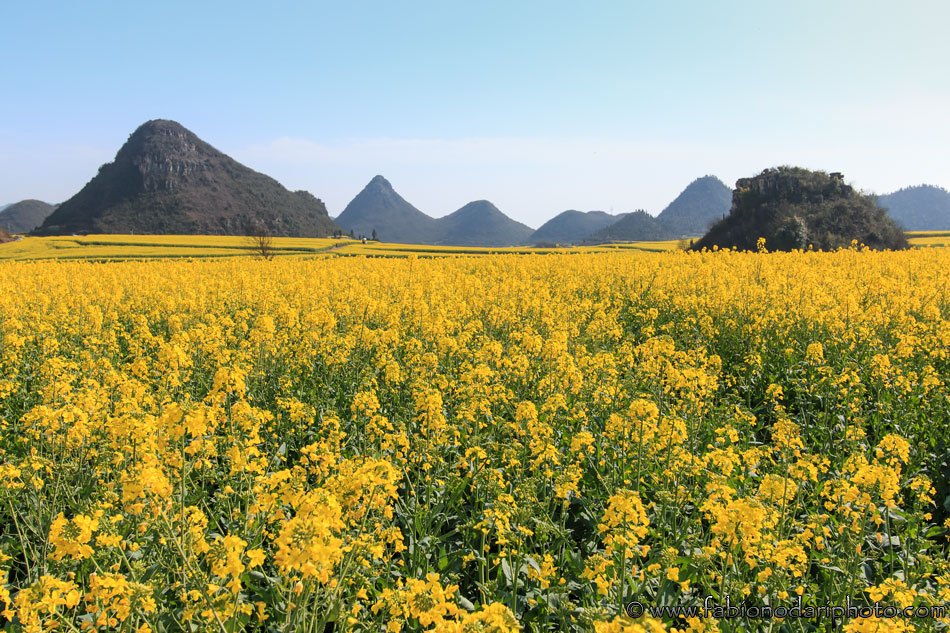
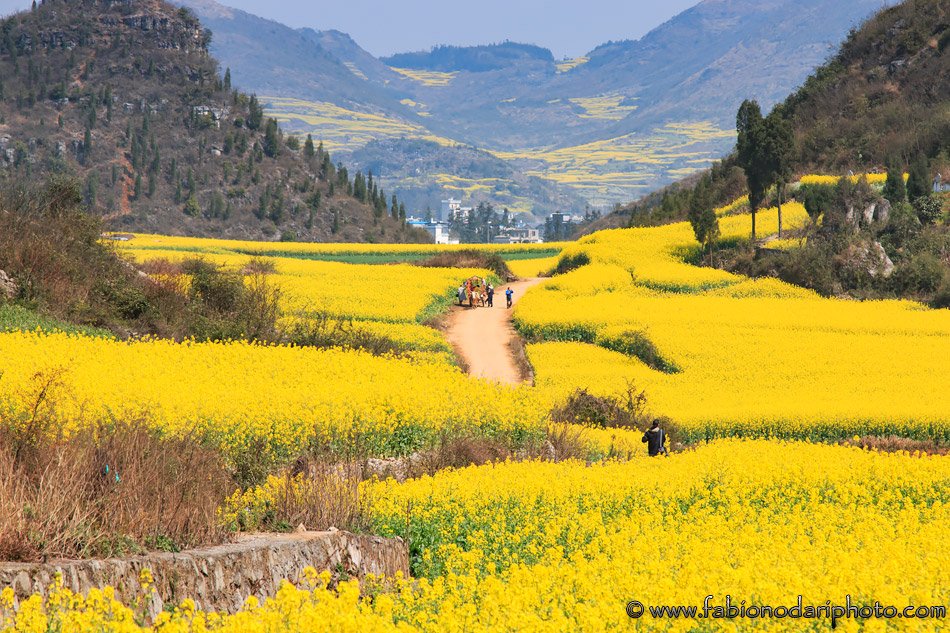
Luoping is a place that really surprised me, and in some ways, it reminded me of Provence. While Provence has become world-famous for its lavender fields, Luoping has carved out its own identity with endless rapeseed flowers.
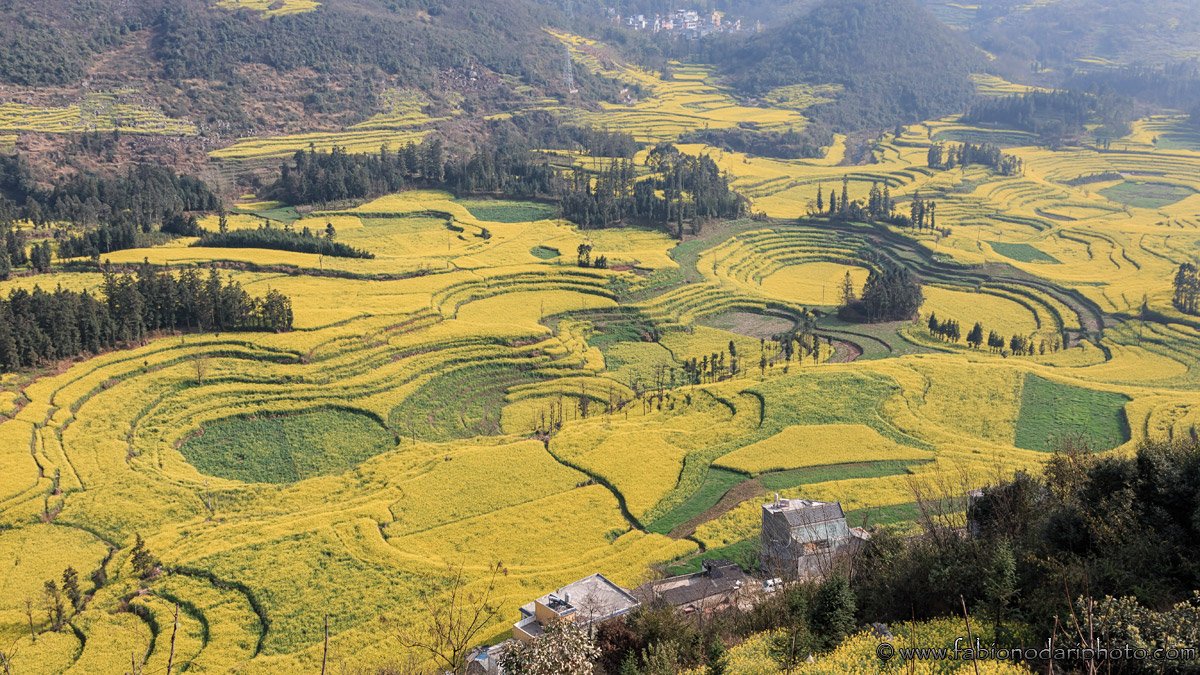
The difference is that Luoping’s scenery feels even more dramatic. The bright yellow fields stretch as far as you can see, but instead of being flat, the landscape is broken up by hundreds of karst hills rising like little islands from a golden sea. That’s what makes it so unique. For photographers, this is a dream location, and even if you are not into photography, it’s impossible not to stop and stare at such an incredible sight. The only other place that gave me a similar feeling of being immersed in a flower landscape is Furano in Japan, famous for its lavender fields, but the vibe here is very different.
Rapeseed in Luoping is not just grown for beauty; it’s an important crop. The flowers are harvested to make oil, biofuel, and even honey, which is a specialty of the region. But what really impresses every visitor is the sheer scale of it. When you stand on one of the viewpoints and look down, Provence suddenly feels like a small garden in comparison. Then again, this is China, a country where everything always seems to be on a bigger scale.
When is the best time to visit?
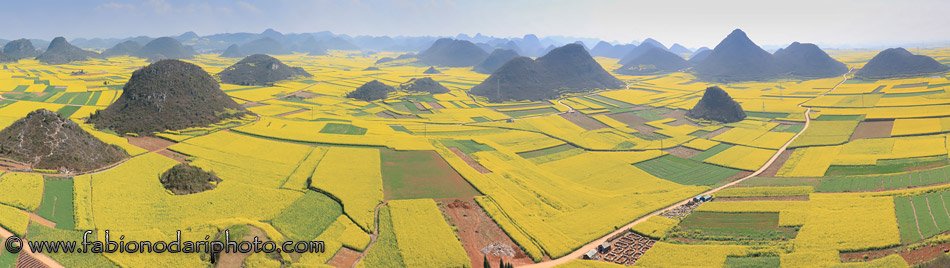
Luoping sits right at the border with Guizhou and Guangxi, which makes it easy to combine with a wider trip through southwest China. But timing is everything here. If you want to see the rapeseed flowers in full bloom, you need to plan your visit between the end of February and the end of March. This is the short window when the fields turn into a golden carpet, just before the Jacaranda trees in Kunming start blooming in May (I wrote an article about that if you are curious). Keep in mind that the exact harvesting time changes every year depending on the weather.
Outside of this season, Luoping loses its main attraction. To be honest, there is no real reason to visit unless you are passing through for another purpose. The flowers will be gone, and what makes this place so special won’t be there.
Of course, canola isn’t unique to Luoping. You can find it growing in many other regions of China, with blooming times that shift depending on altitude and climate. Still, Luoping is famous for having one of the largest and most spectacular fields in the country. Guizhou comes in second, but once you’ve stood in Luoping’s viewpoints and looked out at the endless waves of yellow broken by karst peaks, you’ll understand why this is the place that photographers dream about.
If you are looking for some other ideas for your Yunnan itinerary, check out this page.
How to get there and how to visit
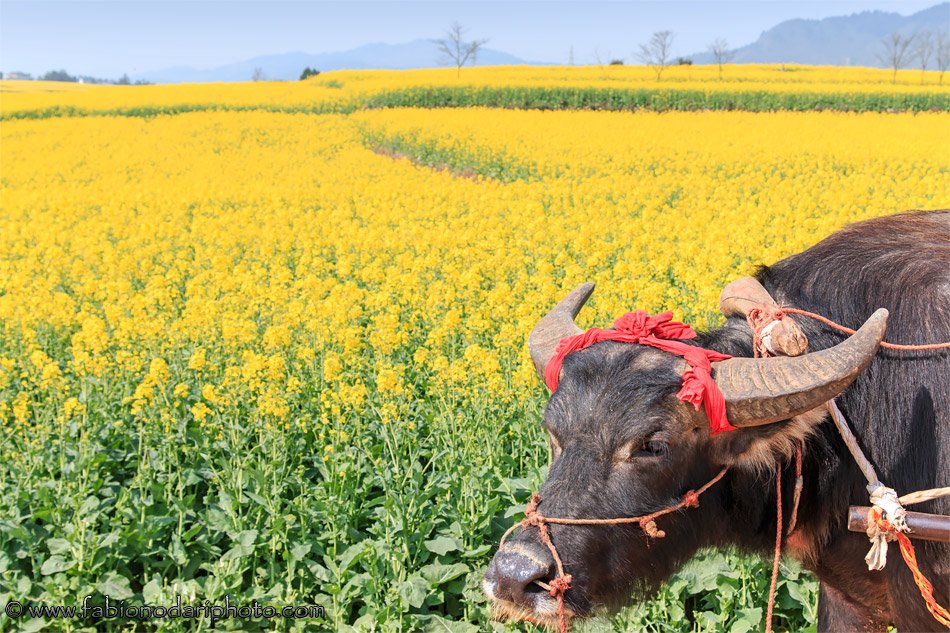
Getting to Luoping is not complicated, but you should know a few things before planning your trip. At the moment, there are only two train options from Kunming to Luoping (罗平): one takes around 3 hours and the other almost 6. While taking the train is possible, it’s not really the most efficient choice. The buses from Kunming East Coach Bus Station are actually faster and more convenient. The station itself is easy to reach since it’s connected to the Kunming Metro, and once you’re on the bus, it will take you directly to the Luoping North Bus Station in town, about 20 minutes away from the main flower fields.
Another option, and the one I personally recommend if your budget allows, is to hire a driver in Kunming. This gives you much more flexibility, especially if you also want to visit the Jiulong Waterfalls, which are not as easy to reach by public transport. A driver can take you there and make sure you don’t waste time figuring out connections. If you’re interested, send me a DM on Instagram and I’ll be happy to share the contact.
Once you’re in Luoping, the best way to start exploring is by heading to Golden Chicken Peak (金鸡峰丛, Jinjifeng Cong). This is the most famous viewpoint and the place where you’ll need to buy your ticket to enter the scenic area.
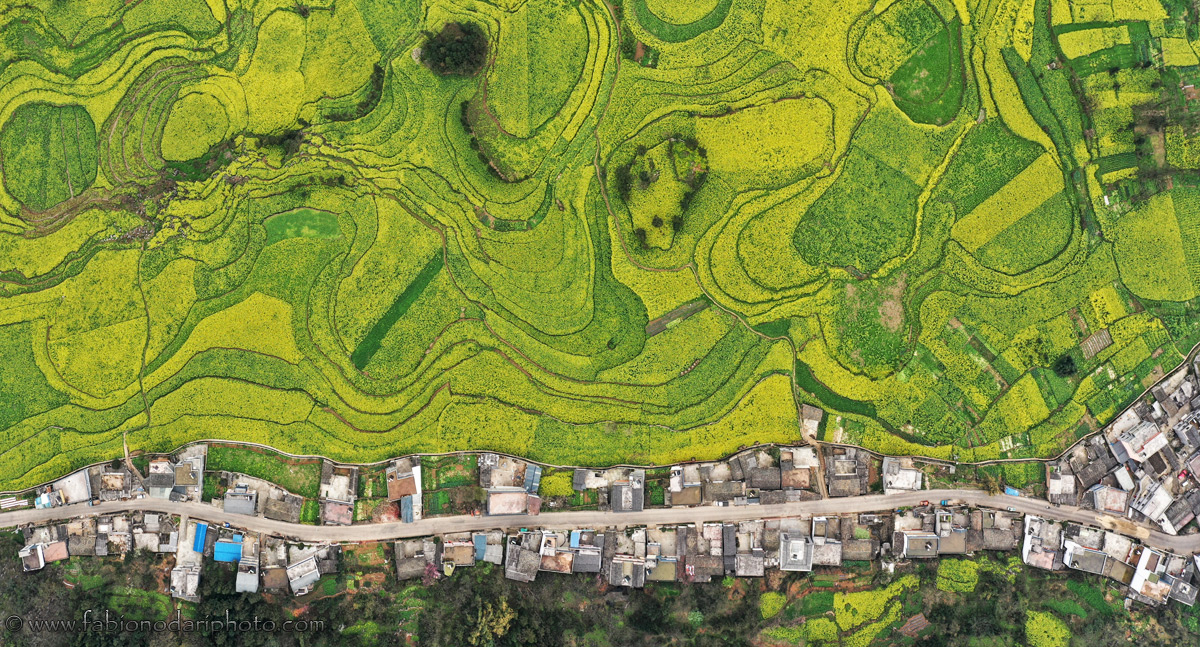
For even better views, you can hike up one of the smaller hills around the fields. From there, the patterns of yellow flowers and karst peaks look even more impressive. Just be careful if you go off the main paths, as the terrain can be slippery. Another option is flying a drone, which allows you to capture the scale of the fields from above. Keep in mind that drones in China need to be registered before you can use them (even if they weigh less than 250g). If you’re not sure how to do it, check this page.
Where to stay in Luoping
If you decide to spend a night in Luoping, make sure to book your accommodation well in advance, especially during the flower season when rooms sell out fast. Hotels here are limited, and while the choice is not huge, you can still find some comfortable places if you plan ahead. I usually book through Trip.com, which has the widest selection for this area and allows you to compare the few options available. At the moment, there aren’t many hotels that stand out, but this one is among the best I’ve tried so far.
If photography is your primary goal, I recommend staying near the 金鸡峰丛 (Jinjifeng Cong) area, since it’s one of the most scenic spots and you’ll be close enough to catch the sunrise.
Excursion to the Jiulong Waterfalls

If you want to add another stop to your trip, the Jiulong Waterfalls (九龙瀑布), or Nine Dragons, are worth half a day. The site features a chain of waterfalls stretching for about four kilometers, with a total drop of more than one hundred meters.
From Luoping Bus Station, take a minibus to Banqiao (30 minutes), then another to the waterfalls (20 minutes). A local driver is a more practical choice, especially if you also plan to visit the Duoyi River or the rapeseed fields. The best route is to enter from the West Gate and walk down to the East Gate.
Beekeepers and Local Honey in Luoping
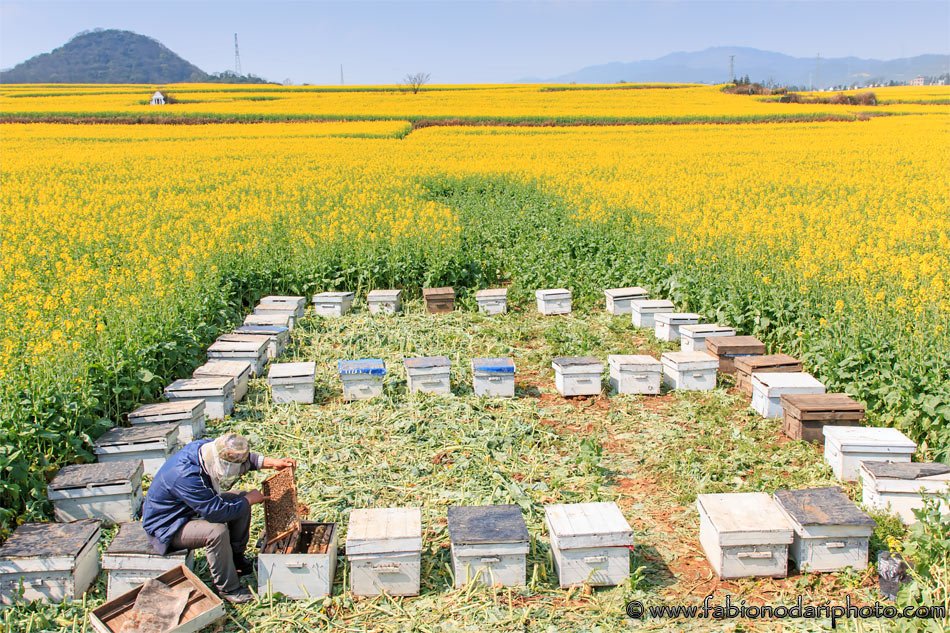
The blooming season is also the busiest time for local beekeepers. During these weeks, the rapeseed fields are alive not only with color but also with the constant hum of bees. You will often see small groups of beekeepers living right by the fields in simple tents or makeshift huts, keeping a close eye on their hives and working long hours to collect the honey. When the rapeseed season ends, they usually move to nearby areas where wildflowers are in bloom, so the bees continue to have a food source.
It’s very common to find them selling fresh honey on the spot. Before you buy, don’t be shy about asking for a taste. Most will be happy to let you sample a spoonful. Just keep in mind that the quality can vary a lot. As a general rule, if the price is suspiciously cheap, it’s unlikely to be the best quality. The good stuff is usually a little more expensive, but it’s worth it, especially since this is one of Luoping’s specialties.
Another thing you’ll notice while walking among the fields is the warmth and curiosity of the local people. Don’t be surprised if someone comes up and asks to take a photo with you. For many, meeting a foreign visitor is still a novelty, and they are genuinely excited about it.
Final Thoughts
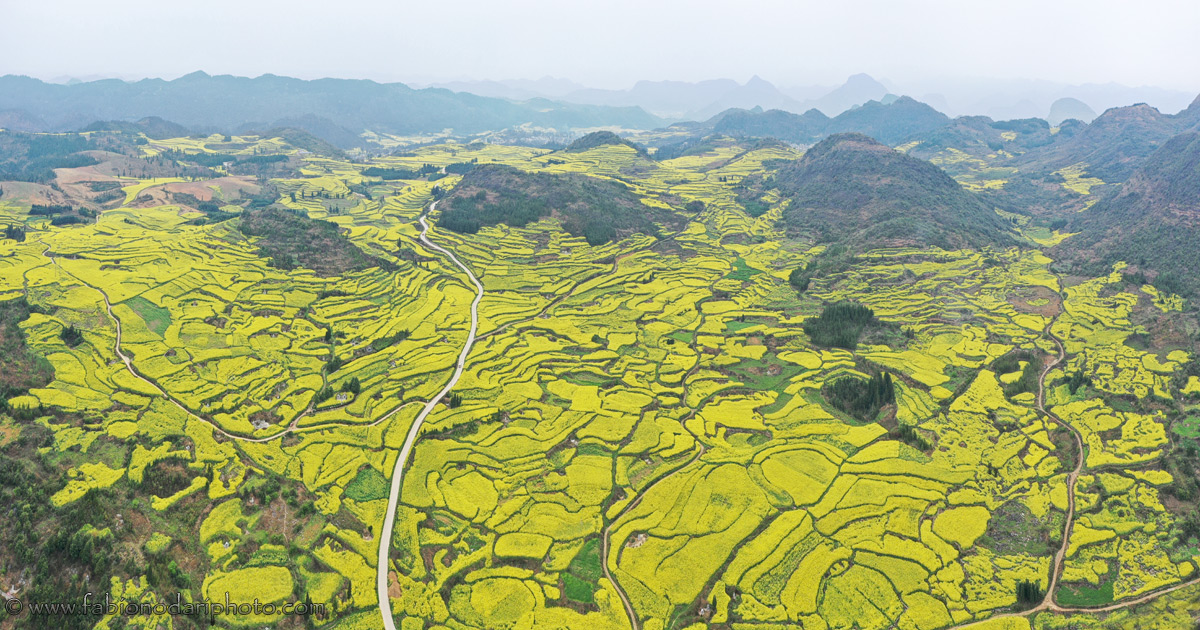
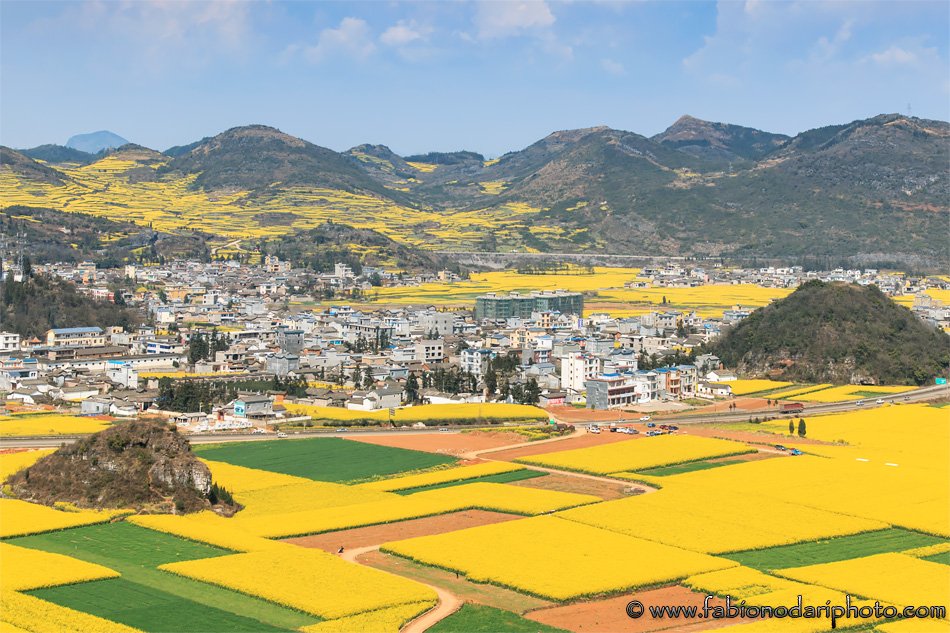
Luoping is one of those places that really leaves a mark, but only if you catch it at the right time of year. The rapeseed fields are the highlight, and without them, there isn’t much reason to come all the way here. Between late February and early April, the scenery is unique and worth the trip. For photographers, it’s a dream, but even if you just enjoy being outdoors, the sight of golden fields dotted with karst hills is something you won’t forget.
If you want to explore a side of Yunnan that is still off the radar for most international travelers, Luoping is a good choice. Just remember, timing is everything.
As always, don’t forget to get an eSIM or Vpn before heading to China. If you need Travel Insurance, I recommend this one.
Here you can find more pictures I took in Yunnan. Here you can read my article about the Jiuxiang caves in Yunnan, and here is an article about the beautiful Shaxi old town.


Do you have a recommendation of where to stay in Luoping that we have a view of the Rapeseed fields from our hotel room? You blog and photos are amazing by the way, thanks so much!
Hi. Thanks for useful blog, lovely pics. How can I find out when the best time to see peak flowers in Luoping? My travel dates are flexible, between Feb 28th and March 14th 2024. Thanks you.
The best way is to use Chinese social media like 小红书 and check tags like 罗平 around that time.
Hi Jack thanks! this is a good option.