
Traditional wooden houses, misty forests, and a slice of Kazakh life on the edge of China’s last wild frontier. Read my Travel Guide to find out what to do and what to see in this beautiful area.

Tucked away in the Altai Mountains near the China–Kazakhstan border, Hemu (禾木村) is famous for its photogenic log cabins that look nothing like the image most people associate with China.
This is one of those places that may look untouched in photos, but in reality, like many remote areas in China, it has seen a significant rise in domestic tourism in recent years. This is partly due to the economic downturn, which has made international travel less accessible, and partly driven by a growing trend among Chinese travellers who are increasingly interested in exploring their own country’s more remote and culturally rich regions.
This being said, while it’s gained attention in recent years, especially among domestic photographers, it remains far less crowded than other scenic spots in China.
Best Time to Visit Hemu

The best seasons to visit Hemu are late September to early October, when the birch forests turn gold, and the air is crisp, and June to early July, when wildflowers are in bloom. Avoid national holidays, especially the first week of May and October.
Winter can also be a great time to visit if you enjoy snow and cold, just be prepared, as it gets very cold and crowded. When I went in January, temperatures hovered around -25°C. The area is also known for having some of the best ski resorts in China, which is a bonus. However, don’t assume skiing in China is cheap: it’s not. Expect to spend around $100 per day.
Where is Hemu Village, and how to get there?

Hemu is located in Burqin County (布尔津县) in Altay Prefecture (阿勒泰地区), in the far north of Xinjiang. It sits about 30 kilometres southeast of Kanas Lake and nearly 700 kilometres from Urumqi (the capital). The village is part of the Kanas Nature Reserve and lies close to the borders of Mongolia, Russia, and Kazakhstan (here is my South-East Kazakhstan Travel Guide).
From Urumqi (乌鲁木齐) fly to Burqin Kanas Airport (布尔津喀纳斯机场), then take a bus or arrange a car to Hemu (about 3 hours). Flights are seasonal and more frequent in summer and early autumn. Send me a DM on Instagram if you need recommendations for a driver.
Tuva and Kazakh Communities
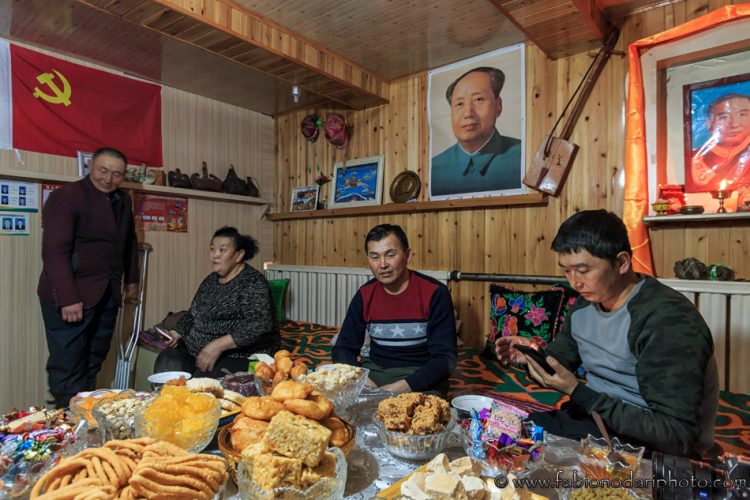

Hemu is one of the few remaining places in China where the Tuva people (图瓦人) still maintain their traditional lifestyle. The Tuva are a Turkic-speaking ethnic group with cultural ties to the indigenous peoples of Siberia and Mongolia. Though not officially recognised as a separate ethnic group by China, they are often categorised as part of the Mongolian nationality.
In Hemu, the Tuva people live in log houses, herd livestock, and speak a dialect related to Siberian Tuvan. If you’re lucky, you might also get the chance to witness Mongolian throat singing, a unique vocal tradition sometimes performed by members of the Tuva community.
Alongside them are members of the Kazakh (哈萨克, Hasake) minority, one of the largest Muslim ethnic groups in Xinjiang. The Kazakhs in the Altay region are known for their horsemanship, eagle hunting traditions, and seasonal migrations.
It’s possible to stay in one of the local homestays, and I recommend it since it’s quite a unique experience. This is one of the many options. Alternatively, you can check Trip.com, which is one of the best options for booking travel within China.
Remember that you must register with the police (公安局) in Burqin (布尔津) before entering the Kanas and Hemu area. This registration is mandatory for both Chinese citizens and foreigners, just like on the Pamir Highway in southern Xinjiang.
Travel Agency vs DIY

Getting to Hemu isn’t as challenging as travelling to other remote areas such as Western Sichuan (here my guide), especially if you simply want to spend a few days in complete relaxation in the village. If you also want to combine your trip with exploring Kanas Lake and other more remote areas, then you should consider getting a driver for one or two days. Send me a DM on Instagram if you need a recommendation.

Hemu looks like a fairytale version of a frontier village: small wooden houses with sloped roofs, smoke rising from chimneys, horses grazing freely, and birch forests that glow golden in autumn.
There are no large hotels within the village itself, just a scattering of guesthouses, homestays, and rustic log lodges. However, you can find many accommodation options just a few kilometres outside the main settlement.
Things to Do in Hemu


What you can do in Hemu depends largely on the season. Watching the sunrise is a highlight year-round. After a short uphill walk, you’ll reach the wooden viewing platforms, where the village looks half-hidden in the morning mist and soft light spills over the rooftops and pine trees.
Spring and autumn are the best times for horseback riding, especially along trails that pass through open meadows and birch forests. Local Tuva and Kazakh families offer guided rides, nothing too intense, but the mountain air and scenery make it memorable. In winter, the experience gets even better, and you can ride a horse-drawn sleigh through the snow.
There’s also a hiking trail from Hemu to Kanas Lake. It’s long but beautiful, crossing forests, rivers, and grasslands. In this case, I recommend asking a local agency for help with logistics. If you need one, I can recommend a reliable option.
Food in Hemu is simple but delicious: try the handmade noodles, lamb skewers, and yak yoghurt. The cuisine in this part of China is unique, much closer to Central Asian flavours than to those of East Asia. Some Tuva families open their homes for short visits, tea, and music, usually arranged through guesthouses.
Exploring Kanas Lake (喀纳斯湖)

Kanas Lake is a glacial alpine lake about 3 hours northwest of Hemu and one of the most iconic natural attractions in Xinjiang. Known for its changing colours and legends of a lake monster, it stretches over 24 kilometres and is surrounded by dense forests and snowcapped peaks.
The lake sits at an altitude of around 1,375 meters and is part of the broader Kanas Nature Reserve. There are well-maintained boardwalks and observation decks, including popular viewpoints like Fish Watching Pavilion (观鱼台), which offers panoramic views.
As in the rest of China, accessing the park is fairly straightforward: you enter through the official gate, take the eco-shuttle to reach the lake, and then follow the wooden boardwalks.
Skiing in Hemu and Altay

Winter in Hemu is long and cold, with snow typically blanketing the region from November to March. The Altay region, where Hemu is located, is gaining recognition as one of China’s most promising ski destinations, not only for resort skiing but also for its traditional roots.
The Tuva people of Hemu are believed to have used skis made of pine wood and horsehide for centuries, one of the oldest ski cultures in the world. China even claims to have invented skiing, but they tend to claim all sorts of stuff, so I don’t believe it. It’s undeniable, though, that skiing is an important part of the local culture. Today, you can see replicas of these ancient skis in local museums and sometimes in use.
I visited Hemu in winter and had the chance to see a local festival where people of all ages competed skiing on the mountain. It was very interesting, especially because I had no idea the local ski culture was so strong.
Skiing options

If you’re visiting in winter, Hemu’s ski resort, Jikepulin (吉克普林滑雪场), is one of the most scenic and under-the-radar spots in China. This ski area has three zones (West, Centre, East) served by modern lifts and offers everything from beginner-friendly slopes to steep runs near the summit at Yunxiao Peak (2,770 m).
The resort is still expanding, with plans for 103 runs covering 108 kilometres, including 12 competition-grade tracks and 28 off-piste trails. Major trails include the Jikepulin, Koktokay, Burqin, and General’s Trail, offering a mix of long descents and varied slopes.
It’s not a huge resort by European standards, but the scenery is beautiful: wide open views, pine forests, and barely any crowds. There’s a shuttle that runs between Hemu Village and the resort (usually mid-morning), and rentals are available on-site.
Final Thoughts

Hemu is geographically remote but still accessible, and that’s exactly what makes it worth the effort. It’s the kind of place where time feels slower, and you get to see a lesser-known side of China that’s far from the usual stereotypes, but just as interesting.
It’s not completely unknown anymore, but if you visit in the shoulder season, you might just find the quiet you’re looking for.
If you are looking for another interesting area to visit, check out my Gansu Travel Guide, an itinerary along the ancient Silk Road. Here’s my complete travel guide to China.
As always, don’t forget to get a VPN or an eSIM before heading to China. If you need travel insurance, I recommend using this one.
Don’t miss this article, where I share my road trip experience in Qinghai, a little-known but incredibly beautiful region.


