
Planning a trip to China? This post covers everything you need to organize it. You won’t find destination guides, but you will get practical tips to help you navigate the country.

This is quite a long article, but I also wrote a quick FAQ article here.
China is a fascinating country with thousands of years of history. Many things we use in our daily lives were invented in China, and I am not only talking about the 4 most famous: paper, the press, gunpowder, and the compass. The list is very long, and you can find it here.
China has also been relatively isolated from the rest of the world since time immemorial, with few exceptions. This means that the most significant difficulty when organizing a trip to China is linguistic: very few people can speak English. However, there is another challenge when visiting China that is strongly related to the language: the culture. It’s impossible to fully understand a person and their culture if you can’t communicate.

In addition, the mass media flood us with bad news that often portrays China as a terrible place. Nothing could be further away from reality: China is politically isolated, but precisely for this reason, the Chinese do not know much about what happens outside and are generally very curious and cordial towards foreigners.
This brief introduction aims to make you realize that before visiting China, you have to forget what you think you know about this country. You will be surprised to know, for example, that China is not the most polluted country in the world.
When is the best time to travel to China, and where to go?

This is one of the first questions you should ask yourself. Unfortunately, most people cannot travel whenever they want. In Italy, for example, people travel around Christmas and in August, during the summer holidays, which are the most expensive periods of the year and not the best time to travel weather-wise.
The other point is that China is a vast nation; therefore, there is no single right or wrong time to visit this country. Summer, for example, is hot and humid throughout Asia, but if you go to Tibet or Western Sichuan, you won’t have this problem. Winter is cold in the north, but the weather is nice and pleasant if you visit Hainan in the south. So here are some tips to help you decide when to visit China:
- Avoid periods around national holidays in China, such as the Chinese New Year, the first 10 days of October and the first week of May. Here, you will find a list of all Chinese festivals. Even if it is not a holiday, August is still considered high season.
- The rainy season usually begins in April. Spring is generally a great time to travel to China.
- Summers are hot and humid throughout China, except for most of Yunnan and on the Tibetan plateau (here’s an epic road trip worth considering), and there are a lot of tourists everywhere. Summer is not the ideal time to travel to China, but unfortunately, many people have no choice. Expect A LOT of tourists pretty much everywhere in August.
- Autumn is generally also a great time to visit China.
- Winters can be frigid, especially in northern China. In southern China, the weather is much better (here’s my guide to Xishuangbanna).
- February and March are, in my experience, good times to travel. The temperatures start to rise, and generally, the sky is clear. It can still be cold in parts of China, but the weather gets more pleasant as the days get longer. In addition, at the beginning of March, flowers start to bloom. March, for example, is the perfect time to visit the canola flowers of Luoping. Remember to check when the Chinese New Year occurs, though. Avoid that week at all costs.
As for the itinerary, I created this page with some ideas for you.
What is the best airline?

To find the cheapest flight, you can visit Trip.com and try different combinations of dates and destinations. When you find a good deal, check directly on the airline website. Generally speaking, most Chinese Airlines are ok: not amazing but not terrible.
Finally, keep in mind that it’s always cheaper to book round-trip flights from the same city, but given China’s size, this isn’t always possible. If the price difference is significant, you can still book your round trip from the same city and check if there are high-speed trains connecting your final destination to the town from which you’ll catch your flight back to Italy.
How to get a Visa

One of the main difficulties of a trip to China is the visa process. I don’t want to give you misleading information, so I recommend contacting the Chinese consulate or Visa For China (in several countries, they provide visas instead of the consulate). Remember that if you want to travel to China as a tourist, you need a tourist visa, and to obtain it, you must make all hotel and airline reservations and provide a detailed itinerary. There are quite a few countries that don’t need a Visa, and the list keeps getting longer.
If, for some reason, you are already traveling around the world and need a Chinese visa, don’t worry. It is possible to apply for it at one of the many visa agencies for China worldwide. Please don’t overstay your visa, as you could get in trouble.
Which travel insurance to choose
I’ll keep it real: public hospitals in China are often a cultural shock for many Western visitors. Unlike the more orderly systems in Europe or North America, Chinese hospitals can feel chaotic and crowded, especially in big cities. Patients usually register at the front desk, pay upfront for consultations or treatments, and then wait in long lines, sometimes in noisy, crowded hallways. Doctors often see a very high patient volume per day, so consultations are quick and to the point, with less emphasis on bedside manner than in Western expectations. Privacy is limited because multiple patients often share the same consultation room or ward.
Despite these cultural differences, Chinese public hospitals generally offer competent and affordable care, though many prefer private or international hospitals for more comfort and English-speaking staff. Because of this, I always make sure I’m covered with SafetyWing’s Nomad Insurance when I travel in China. It covers unexpected medical expenses, including hospital visits, which gives me peace of mind when I’m far from home. What I really appreciate is how easy it is to sign up online, even if you’re already abroad, and that it works on a monthly subscription model, so I can keep it active as long as I’m traveling. It’s affordable, flexible, and includes coverage for travel delays and lost luggage, too. The peace of mind is worth every penny. Don’t take for granted the risks of not having proper health coverage when traveling in Asia.
How to book hotels that accept foreigners

Hotels in China deserve a particular post. I have been to many different kinds of hotels on my trips, from the best to the worst. I was, for example, in the oldest hotel in China, opened in the early 1800s in Shanghai, where Albert Einstein and Bertrand Russel also spent some nights (the photo above is the hotel’s ballroom). Once, I ended up in a hotel at an elevation of about 3000 meters during a snowstorm, and there was neither heating nor hot water! There were 3 degrees in the room. And I also camped at an elevation of 4500 meters in winter.
Most of the time I traveled around China, I hadn’t had such traumatic experiences. Still, I can say that Chinese hotels usually have much lower standards than we are used to, especially if you get away from big cities like Beijing, Shanghai, or Guangzhou and try to save money.
Two of the problems with Chinese hotels are the beds and the cigarette smell. According to Chinese medicine, the mattress should be hard, which you’ll find in most hotels. Only the most expensive hotels (4 or 5-star) have soft mattresses. On top of that, it’s very common to find a smelly room even in good hotels.
Finally, the food. Don’t expect to find coffee and an international breakfast in cheap Chinese hotels. You’ll find soup noodles and rice.
In short, you can spend little on hotels in China, but you must be willing to adapt. Booking.com offers great deals, but Trip.com is the best option. Some hotels refuse to host foreigners. In this article, I explain why and what you can do.
How to get around China

One of the most important things to plan for your trip to China is transportation. It’s a vast country, so you’ll need to plan your itinerary carefully or risk wasting time traveling from one corner to the other. Moving around China is relatively cheap, especially if you don’t mind taking local buses.
Depending on the distances to be covered, you have several options. Remember that you will always need a passport to purchase a train or bus ticket.
Airplane

Flying is the best option for longer distances, such as Beijing-Shenzhen, unless you want to spend 2 days on a train. Once I did it, I traveled for 33 hours. It was an interesting experience, but I don’t recommend it to everyone, especially if you have a few days available.
The problem with Chinese airlines is that their websites are only in Chinese; sometimes, they don’t even accept non-Chinese credit cards. In those cases, booking a ticket using Trip is the only solution. There are some low-cost airlines in China, but not as cheap as Ryanair in Europe.
Train
Trains are my favorite means of transport when traveling around China. A train allows you to get to know local people, and you’ll get to see amazing places. Taking a local train is quite an experience, especially if it’s your first time. First, a distinction must be made between regular and fast trains. Regular trains often depart and arrive at stations that are completely different from those of high-speed trains and are much slower.
Given the number of Chinese travelers, I don’t recommend buying your ticket at the station on the same day of departure, as it will most likely be sold out even though trains have many carriages. Unfortunately, you also can’t buy it months in advance. Tickets are only released for sale 15 days before departure. You can pre-book them online, but the actual confirmation only arrives once the tickets officially go on sale.
The best way to purchase them is through Trip because it’s very easy to use and accepts Western credit and debit cards.
These are the main types of tickets on sale for each REGULAR train:
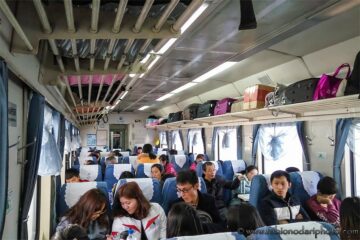
Hard seat: as you can see in the picture, these are seats (hard and not reclining) in rows of three. It’s the cheapest but the most uncomfortable solution for a train trip. I don’t recommend this option unless you need to take a short trip or have a very tight budget.
After spending about 7 hours in one of these seats, I won’t repeat that experience. It was awful.
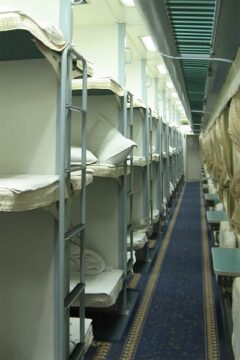
Hard sleeper: the ideal solution if you are not interested in privacy. These are wagons with rows of bunk beds, one after another. Each compartment has three bunk beds in front of three other beds: 6 beds per section, but no doors. There are some reclining seats along the corridor, but they are few.
When purchasing a you can choose which bed to sleep on: the lower bed, the central bed, or the upper bed. Remember that you’ll have to spend all the time in the bed assigned to you. So if you are in the upper bed, it’s uncomfortable because you don’t have enough space to sit.
Remember also that if you don’t get on the train at the departing station, chances are somebody was on the bed assigned to you before you got in, and the blankets and pillows aren’t changed until the train reaches the final destination… Most of the time, I choose this option if a high-speed train is unavailable. If it’s your first trip to China, maybe the next option is better.

Soft sleeper: the name is misleading because the mattresses aren’t soft. The main difference instead is that there are private rooms with 4 beds each. This type of ticket is slightly more expensive than the hard sleeper. It’s ideal if you travel with a group of friends.
Soft sleeper (in 1-bed compartment): tickets of this type are available for some destinations. As the name says, it’s a room with only one bed. The price is relatively high, and I haven’t had the opportunity to try this option yet.
Standing: Once all tickets in the Hard Seat car are sold out, you can buy standing tickets. They have the same price as the hard seat ticket. This ticket is only helpful if you need to reach a destination and have no choice.
Fast Train or Gaotie

Among all the records held by China is that of the world’s most extensive high-speed railway system: more than 10,000 km and counting. The incredible thing is that the first line was opened on April 18, 2007!
As with regular trains, if you want to buy a ticket, you must book in advance, especially for popular routes such as Shanghai-Beijing. The stations are often as large as small airports and are very clean. Prices are higher than regular trains but are not too expensive. Fast trains are the best way to get around China quickly if the distances are not excessive.
Bus

Long-distance buses are often the only option, not an alternative to other modes of transport, especially if you travel to remote areas. They are generally comfortable and cheap. For popular routes, buy your ticket a day earlier. Night buses have beds instead of seats. As I explained at the beginning, remember to bring your passport, or you won’t be able to buy a ticket. At the moment, foreigners cannot book bus tickets online.
Minivan
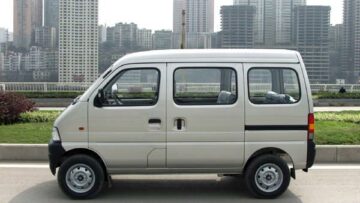
As with buses, minivans are often the only solution. In remote areas, they replace public transport. Most of the time, you can negotiate the price. Prices are low as long as you know how to bargain. These minivans are quite uncomfortable, especially if you have to spend many hours in them, but a trip to China isn’t complete without at least one ride in a minivan…
How to get around Chinese cities

Getting around Chinese cities is easy, and your choice of transportation mainly depends on two things: the distance to your destination and your knowledge of Chinese. I recommend using AMAP, the equivalent of Google Maps, which is now available in English.
Subways are found in almost all major Chinese cities. Shanghai’s system (here’s my guide) is the longest in the world, while Beijing’s (here’s my guide) is the busiest in terms of passengers. The one in Chongqing is the most spectacular.
Taxis are cheap, but the best solution is to use apps like Didi (the Chinese version of Uber), which is available in English and saves you a lot of time since you don’t have to look for a taxi or explain where you’re going. For short distances, you can hop on one of the many scooters waiting near subway stations. Recently, bicycles have also come back into fashion in China, thanks to numerous bike-sharing services, and in some cities, you’ll even find e-bikes. However, to use them, you’ll need a Chinese phone number.
What to eat

Talking about Chinese food is challenging, given that China is as big as Europe, which means a great variety of dishes. Each province has its typical cuisine. Another thing to keep in mind is that there are 56 officially recognized ethnic minorities, each with a characteristic dish. That said, there are things you’ll find almost everywhere, like noodles, hotpot and fried rice.
The advice I can give you is to try street food, but pay attention to where you eat. A good reminder: if something you have on your dish touches the table, do not pick it up. In most restaurants, water is not usually served. They’ll give you tea instead, but you can bring your water bottle.
If you have problems with food intolerance (for example, celiac people), China is, in theory, the ideal country because most of the dishes are made with rice. In practice, things are more complex. Restaurants use the same pots to cook both rice-based and flour-based dishes. The best solution is to buy and cook the ingredients yourself, especially if you have a serious intolerance. Keep it in mind if you are planning a trip to China. Finally, remember that you are not supposed to tip the waiters in China.
How to use the Internet

Everyone in China uses WeChat, which is essential for communication and offers many features you will use during your trip. The other app used for everyday payments is Alipay. Along with WeChat, it has replaced cash in China for several years now. Both apps have an English translation feature for every mini-app you use.
Almost all foreign sites and apps are censored, and you can only use them if you have a VPN. I recommend this one. Remember that ExpressVPN and NordVPN do not work in China.
Regarding the SIM card, you basically have two options: eSIM or a physical SIM. Each has pros and cons. With an eSim, for example, you don’t need a VPN, but you don’t have a phone number, which is often required to create accounts on Chinese apps. The physical SIM requires a VPN but costs less, and the internet traffic is faster.
No one solution is better than others. It depends on what you prefer. If you prefer to use an eSIM, I recommend this one. If you use my link, you get a discount. If you want to buy a physical SIM, you can go to a store or use this site, which lets you order a Chinese SIM and get it directly at the airport.
Guided Tour or DIY Tourist?

At the end of this article, I hope you have a better idea of what to expect from a trip to China. If you think you can do it, I recommend organizing the trip yourself: you’ll save a lot of money. If you don’t feel like you can do it, or you are traveling to a remote area, then rely on an experienced travel agency.
I collaborate with many different travel agencies specializing in different areas of the country. If you need a recommendation, feel free to DM me on Instagram.
Is China a safe country?
Simply put, yes, China is a safe country. One of the things that always strikes those who visit this country for the first time is the high number of police and security guards. Some people may try to scam you, but it is very rare to hear news about tourists being robbed or similar incidents, even though we are talking about the most populous country in the world. This is a stark contrast with neighboring Vietnam, as I unfortunately experienced.
Living in China

Many people are curious about what life in China is really like, and more and more are open to trying it for a short period rather than making a long-term commitment right away. The country offers a mix of opportunities, cultural depth, and everyday challenges that you can’t fully understand as a tourist. Living there, even briefly, gives you a completely different perspective.
A short study experience is one of the easiest ways to make that first step. Instead of feeling lost, you have a base to start from, making the whole experience easier. It’s a practical way to test life in China and see if it’s something you’d want to explore further.
If you are interested in this sort of experience, I recommend the same school where I first studied when I moved to China. This is their email contact: [email protected]. They have many campuses in the major cities across China. If you mention my name (FABIO), they’ll give you a small discount.
Other helpful tips for your trip

If you need to exchange money into RMB, the only place you’re officially allowed to do so is the Bank of China, and it takes a lot of times. I recommend using an ATM to get some RMB. You won’t really use cash. I recommend taking with you maybe only 100$ just for emergencies.
For translation, a very useful app is Microsoft Translator, which works even offline. Another essential tool is Pleco, especially for translating Chinese characters and checking pronunciation.
One last thing: gestures won’t help you much here. While Italians are used to communicating with their hands, in China, most gestures are not understood at all, not even basic ones like numbers. The hand signs for numbers are completely different. For example, 6 and 10 are among the most commonly used and can easily confuse you at first.

If you don’t know what to visit in China, I recommend starting with Yunnan, my favorite province. I’ve written extensively about it on my blog. Here is my Yunnan travel guide, along with a few ideas for your Yunnan Itinerary.
Check this page for ideas about great places to visit in China. Here, you can read an article about the curious and weird Snub-Nosed Monkey, one of the species native to China. Here is my travel guide to Zhangjiajie. If you are considering moving to China, check out this article.
One of the most interesting places I visited in China is Dulongjiang, famous for its women with tattooed faces.


We are travelling to China in September. Our phones are not esim compatible. Which physical esim should I buy before I travel that will give me a local Chinese number as well as data.
You can’t buy it abroad. You need to buy a physical sim when you arrive.
Hi Fabion. I’m a huge China fan too and have visited several times. I was in Yunnan in March this year and loved it, stayed with Brian and Cindy Linden in Xizhou. I live in Cape Town and putting together a group of six senior travelers to discover China in October 2026. Yunnan is definitely in the plan. Where are you based and would you offer a guide/drive service to a small group for the time we are in Yunnan? I’ll be the tour leader but need someone who speaks mandarin/English. Kind regards Liz Linsell
Hi Elizabeth. I’ll contact you by email.
What a great article! We’re currently dreaming of going to China again – we’ve been
there before and we love, love love it! Here’s to a year with loads of travel plans and new experiences!
– Veronika
Thanks Veronika!